Showing posts with label interview. Show all posts

Sunday, February 5, 2012

Interview with Susan Campbell Bartolleti, Author

I am so excited to bring you this interview with Susan Campbell Bartolleti, as a part of the Sydney Taylor Book Award Blog Book Tour sponsored by www.jewishlibraries.org/blog, and the official Sydney Taylor Book Awards. The full blog tour schedule will be posted at www.jewishlibraries.org/blog - go see which of my friends are participating and meet some new folks!
Her book, Naamah and the Ark at Night, is a sweet lyrical poem combined with gorgeous illustrations. As I told Susan when I sent her my interview questions, Sam and Yael really liked the book - which might trump any award, right? 


Will you share a little bit about yourself and your journey towards becoming a writer?

Thank you for inviting me to participate in this interview.  I’m really excited about this blog tour.  I’m grateful to the Sydney Taylor award committee for Naamah’s honor.

My journey to becoming a writer was a bit slower than some writers I know. I wasn’t one of those writers who knew she wanted to become a writer as child.

I’ve always loved to read. I’ve always loved stories of all kinds, good and bad. But I didn’t begin to write seriously until I became an eighth-grade English teacher.

My students wrote poems, short stories, and essays. They researched, wrote, and illustrated their own nonfiction picture books and other work. They held poetry readings. They kept writing journals. They published their work to the school’s award-winning literary magazine, which I co-advised.

It felt good to see my students grow as writers. They inspired me to practice what I preached. As they wrote poems and stories and essays, I did, too. Our classroom became one large writing group. They brought their work to class; sometimes I brought mine. Together, we would figure out what makes a good story and how to make a story better.

The first big discovery that a writer makes is her voice and audience. My students helped me discover that I wanted to write for young readers.

I sold my first story to Highlights for Children in 1989. By 1997, I had published short stories, two picture books, and a nonfiction book. I had a novel and another nonfiction book under contract.

The time had come for a difficult decision.

For eighteen years, I had a career that I loved – teaching. Was it time for another? Could I make it as a full-time writer?

“Leap and the net will appear,” a friend told me. (That friend was Laurie Halse Anderson.)

And I did.

And it did.

I’m lucky to work that my hands, my head, and my heart love.

What inspired you to write the story of Naamah?

A very old wooden ark that sits on a shelf in my dining room.
Susan sent me this photo of her old wooden ark.

As a little girl, when I visited my grandmother – my father’s mother – I played with the ark.

I lined up the animals, two by two, and boarded them safely. I imagined the falling rain. The rising floodwaters. The ark tossing and turning on the churning sea.

The ark now sits on a shelf in my dining room. One day, several years ago, I found that my imagination turned to Noah’s wife. In the book of Genesis, we’re told that Noah was a just man, full of grace, who pleased God. But who was Noah’s wife and what kind of a person was she?

I began to imagine this woman who spent more than a year on an ark filled with animals. I began to ask: what did she think when Noah told her his plan? How did she feel packing her house? When the rain began to fall? Surely the neighbors must have noticed. What did they think as Noah hammered and sawed away? When Noah gathered the animals? What did her sons and her daughters-in-law think? How did it feel when the floodwaters rose? What did it feel like to leave all those terrified people behind? What was life like on the ark?

The answers to these questions led me to write different versions of the story. None of those versions “worked,” and so I tucked the story away. It sat in my drawer for many years. Every so often, I’d return to the story and try again.

Then one day, I realized that I wasn’t asking the right question: What was Noah’s wife’s name?

Many people have suggested various names over the years.  In 1941, an American scholar named Francis Utley listed 103  different names for Noah’s wife.

From my research, I learned that some rabbinical legends tell us that Noah’s wife was called Naamah because her deeds were pleasant. (These legends also tell of another Naamah whose name meant “great singer.”)

I liked that, and the interpretations of the name Naamah helped me imagine her personality and her talents. They helped me imagine how a woman might have inspired and comforted her husband and their three sons and their wives, the animals, and herself during all those days and nights afloat.

Perhaps Naamah sang.

You explain at the end of the book that you chose the ancient poetic form of the ghazal for this book. What inspired you to do so? Why did that format fit in with the story of Naamah for you?

A few years ago, I heard my friend and colleague Molly Peacock read a poem that she termed a “sonnet-ghazal.” Molly’s hauntingly beautiful poem gave me goosebumps.

I knew what a sonnet was, but I didn’t know what a ghazal was. As I read more ghazals and learned more about them, I felt drawn to the form for Naamah’s story. Once the story had a form and Naamah had a name, the words poured out in the first draft, with little revision and very few changes after that.

Strictly speaking, a ghazal (pronounced “guzzle”) comes to us from the Middle East.  It’s an Arabic word that means, “talking to women” and the subject of a ghazal is usually longing and loss. (How perfect is that meaning for Naamah’s story?)

The traditional ghazal is so beautiful! You can find examples by conducting an internet search online.

Many Western poets take liberties with the traditional form, as did I.

What is your own favorite children's book or books? Do you read and find inspiration in other authors' work?

I continue to read and to write a lot of poetry. I always try to read the most recent Best American Poetry Series.

I don’t have a favorite children’s book. I love so many! I’m presently reading Jack Gantos’s Dead End In Norvelt. (I’ve already laughed out loud twice!) Another book I loved from last year was Gary Schmidt’s Okay for Now.

There's a great deal of variety in the subjects of your books - a lot of historical fiction but also some sillier subjects like some of your picture books.

I am equal parts silly and serious.

How do you come up with new and different ideas for your work?

One of my grad-school professors once remarked that I have a “lively intellect,” and I suppose that’s true. I’m curious. I ask a lot of questions (which can be annoying). I have a passionate desire to learn more and to puzzle things out.  I enjoy the intellectual process and the physical process. I like fitting the pieces together, thinking in new ways – and this always leads to new ideas.

How did Naamah fit into the other books you've written?

For me, Naamah story’s was the perfect emotional arc to They Called Themselves the K.K.K.

I often write about tragic and dark times in history. In my other work, I’ve explore the lives of the disenfranchised, the exploited, the victimized, and the silenced -- from the pain of child labor in Growing Up in Coal Country and Kids on Strike!, to the trauma of famine of Black Potatoes: The Story of the Great Irish Famine, to the horrors of the Third Reich in Hitler Youth: Growing Up in Hitler’s Shadow and The Boy Who Dared, to racial violence in They Called Themselves the K.K.K. is a continuation of this interest.

Authors often say that their books are like children to them, and they’re right. As I researched and wrote about these things, the subject matter kept me up at night, made me cry and made me angry, made me worry, and made me frustrated, and yet my research inspired me and filled me with wonder and awe at the courage of the human spirit.

And yet, I wonder: How do people survive dark times? Perhaps by holding on to hope and faith and trust through the night, just as Naamah must have done.

Holly’s art is awesome, in the true sense of the word. I love how she depicts Naamah moving through the night, carrying that candle.  That’s the answer, isn’t it? To shine a light on the darkness and to keep moving.


The illustrations are truly gorgeous.
How do you find that you best create a balance for yourself in your family life and writing?

[Insert maniacal laughter here.]

It’s hard.

Writing is pretty all-consuming.

I believe we make the time to do the things we really want to do. I want to write books, and so I make the time to write. I want to spend time with my family, and so I make that time, too.

Sometimes the balance needs an adjustment. I’m on a tight deadline right now, and the other day, my very grownup daughter and mother of three under three  said, You know, Mom.  I really hate it when your characters see you more than I do.

I’ve got her and the grandbabies penciled in.


A huge thank you to Susan for participating in this blog book tour, and mazel tov on your award! Please don't forget to visit the rest of the STBA Blog Book Tour at www.jewishlibraries.org/blog.


*The Sydney Taylor Book Award is presented annually to outstanding books for children and teens that authentically portray the Jewish experience. Presented by the Association of Jewish Libraries (AJL) since 1968, the Award encourages the publication and widespread use of quality Judaic literature. Gold medals are presented in three categories: Younger Readers, Older Readers, and Teen Readers. Honor Books are awarded silver medals, and Notable Books are named in each category. Thirty-three outstanding books were selected from among the over one hundred and twenty titles evaluated by the Sydney Taylor Book Award Committee during 2011. The Committee recommends them for library, classroom, and home use. List of all 2012 Award, Honor, and Notable Books.

Monday, February 7, 2011

One is Not a Lonely Number {Interview}

One Is Not A Lonely NumberI am so excited to bring you this interview with Evelyn Krieger, author of One is Not a Lonely Number, Sydney Taylor Honor Award* win in the older readers category. This book tour is brought to you by the Association of Jewish Libraries (blog at www.jewishlibraries.org/blog), and the official Sydney Taylor Book Awards. The full blog tour schedule will be posted at www.jewishlibraries.org/blog - go see which of my friends are participating and meet some new folks!
Will you share a little bit about  yourself and your journey towards becoming a writer?
     I've been writing all my life.  I always viewed the world in stories and enjoyed telling them. I still have diaries I kept as a teenager. I began writing professionally after starting my teaching career.  My first sale was an article to Learning Magazine.  First graders give you a lot of material!  Initially, I focused on classroom experiences and the teaching of reading, but I couldn't let go of my first love--writing fiction.  I continued to write short stories and hone my skills for a long time. Eventually, I had some small successes.  Writing a novel remained a life-long ambition.  I  made two attempts, but didn't finish.


What inspired you to write this story? I see from your biography that you are one of six kids, what brought you to a story about an only child?
When you are the oldest of six kids, its only natural to occasionally wonder what it's like to be an only child.As part of my preparation for the book, I interviewed only children--both kids and adults.  I remember a first grader who wanted a sibling so badly that he invented his mother's pregnancy for show and tell. And I fell for it! I was also inspired to include the theme of Jewish hospitality in my story.  This is something I've witnessed first hand. Some people really take the mitzvah to heart and open their home, not just to friends, but to strangers from all over the world who need a place to stay or a shabbat meal.   I've had a few readers ask me if there really are people like the Schumachers.  I tell them, absolutely!


Do you see numbers in the way that Talia does? What brought you to write a story with such a mathematical story line?   I don't see numbers in the way that Talia does, but I am fascinated by people who do. I would say I've developed a later-life interest in math.  My work as a learning specialist and tutor made me think a lot about why kids struggle with math, or at least, say they don't like it.   I wanted to have a female character who is not only good at math, but who thinks about numbers in a very unique way.  My young readers have enjoyed this element of the story. The One Is Not A Lonely Number bookmark says, "What color is your favorite number?" I plan to ask that at my book signings and writing workshops.  

What is your own favorite children's  book or books?  Charlotte's Web and Horton Hears a Who are two books I never tired of reading to my children.  The first Jewish children's book I read was Sydney Taylor's All-of-a-kind Family which my mother bought me at a book fair when I was eight years old. So that adds a special touch to winning this award!

Do you read and find inspiration in other authors' work? Definitely.  I seem to always read with a third eye, noticing the author's slight of hand, admiring the language. I strive to learn from the masters.   I especially enjoy good memoirs like The Glass Castle by Jeanette Walls and Devotion by Dani Shapiro.

I see that you're a homeschooling mom as well as a writer. How do you best create a balance for yourself with your writing and your family life?  This has been an ongoing challenge since I became a mother.  My three kids are teenagers now, so in some ways it has gotten easier to find time to write.   Planning ahead for writing time makes me feel less anxious about all those unfinished projects.  I write at Starbucks every Sunday afternoon. Getting out of the house to write is important for my concentration. Even though I have a comfortable home, I get too distracted. I also write while my homeschooled daughter is involved with activities and classes.  When I have a writing deadline, my family knows that I'll get very cranky if I can't finish on time. They are all very patient and supportive,  Shabbat is a regular part of our family life, so that helps give us time to be together without my laptop in sight.  

Evelyn, thanks so much for participating in the book tour!
Mazel tov on your award! May you continue to write and share your stories with the world!

One is Not a Lonely Number was a great read. I couldn't put it down! I especially enjoyed the little touches of math that made Talia such a smart character. I love a good "smart girl" book - so important to create those kinds of role models! I recommend this book for any of the "older readers" (probably 4th grade and up) in your life, only children or those with siblings.

Follow the rest of the STBA Blog Book Tour at www.jewishlibraries.org/blog!

Evelyn, thanks so much for participating in the book tour!
Mazel tov on your award! May you continue to write and share your stories with the world!


One is Not a Lonely Number was a great read. I couldn't put it down! I especially enjoyed the little touches of math that made Talia such a smart character. I love a good "smart girl" book - so important to create those kinds of role models! I recommend this book for any of the "older readers" (probably 4th grade and up) in your life, only children or those with siblings. 

Follow the rest of the STBA Blog Book Tour at www.jewishlibraries.org/blog!

*The Sydney Taylor Book Award is presented annually to outstanding books for children and teens that authentically portray the Jewish experience. Presented by the Association of Jewish Libraries (AJL) since 1968, the Award encourages the publication and widespread use of quality Judaic literature. Gold medals are presented in three categories: Younger Readers, Older Readers, and Teen Readers. Honor Books are awarded silver medals, and Notable Books are named in each category. Thirty-three outstanding books were selected from among the over one hundred and twenty titles evaluated by the Sydney Taylor Book Award Committee during 2010. The Committee recommends them for library, classroom, and home use. List of all 2011 Award, Honor, and Notable Books.

Thursday, February 4, 2010

Interview with Deborah Bodin Cohen {AND giveaway}

Nachshon, Who Was Afraid to Swim: A Passover StoryI am so excited to bring you this interview with Deborah Bodin Cohen, author of Nachshon, Who Was Afraid to Swim: A Passover Story, silver meal winner in the Sydney Taylor Book Awards* younger readers category. This book tour is brought to you by the Association of Jewish Libraries (blog at www.jewishlibraries.org/blog), and the official Sydney Taylor Book Awards. The full blog tour schedule will be posted at www.jewishlibraries.org/blog - go see which of my friends are participating and meet some new folks!

 
Will you share a little bit about yourself and your journey towards becoming a writer?
I am a Reform rabbi and Jewish educator in Cherry Hill, NJ. My husband, David, is a journalist at the Philadelphia Inquirer. We have two great kids – Arianna, an inquisitive 2nd grader, and Jesse, our bright-eyed 2-year old. I grew up in Maryland, where my parents and sister still live. I have lived in lots of places – Ann Arbor, MI, Monterey, CA, New York City, Jerusalem, Washington, DC, the Research Triangle of North Carolina . . .
I have always loved writing. From an early age, I can remember writing and illustrating stories. I have also been an avid reader since childhood. As an adult, though, I was inspired by Midrash, the classic Rabbinic technique of finding new stories through hints in the Biblical texts.   


What inspired you to write Nachshon's story? 
The Midrash of Nachshon – the first Israelite to have faith to walk into the Red Sea – has always spoken to me. Because of the Nachshon’s courage, God splits the Red Sea and the Israelites walk to freedom. The Torah mentions Nachshon ben Aminadav only a couple of times. Rabbinic creativity filled in the gaps in the Biblical text and the wonderful, classic Midrash of Nachshon was born. I love the lessons of Nachshon’s story: the power of one person to make a difference, having faith in face of adversity and taking risks for the benefit of the community.   
I thought that the Midrash of Nachshon would make a great picture book. For quite a while, though, I could not find just the right angle to translate it for children. Then I spent a summer watching my daughter Arianna, who was 4 years old at time, struggle to learn to swim. Arianna, typically brave in most situations, was anxious and fearful in the water.  
All children, really all people, are fearful of something. I began to envision Nachshon as a young boy, brave about most things but fearful of the water. I thought that Nachshon’s fear of water made the classic Midrash even more poignant and meaningful.
 
What kind of input do you have into the illustrations that are chosen for your books?
Before I started writing children’s books, I envisioned the author and illustrator working side by side. In my experience, nothing could be further from the case. I have had five illustrators work on my books and I have not met or even spoken with any of them. At most, we have exchanged a few emails. 
In my experience, once a manuscript is complete, the publisher finds an illustrator. The illustrator may or may not have questions for me. Often, I do not see the illustrations until the project is complete.   
At first, this process felt backward to me. It takes confidence to turn over a manuscript and let somebody else finish the project. After having several books go to print, I have grown to see the wisdom in this process. I have liked the pictures in all of my books. Without my interference, the illustrator can fully develop his or her own approach to the story. The project becomes a true collaboration between illustrator, editor and author.   
Jago, the illustrator for Nachshon, lives in England. We have become Facebook friends.(Jago is being interviewed today over at Jewish Books for Children)


What is your own favorite children's book or books? Do you read and find inspiration in other authors' work? 
I probably have too many to list. My favorite Jewish children’s book is Hershel and the Hanukkah Goblins by Eric Kimmel. It is fun, well written and has a good message. I read it every year to the whole religious school at my congregation and, at home, to my own children many times during the holiday.
Engineer Ari and the Rosh Hashanah Ride (High Holidays)I read all the time and, over the years, have accumulated a rather large library of children’s books for my children. I am sure that other books have influenced my own. For example, I wrote Engineer Ari and the Rosh HaShanah Ride when my daughter was going through a Thomas the Tank Engine stage. But, I think that other influences – the Biblical text, historical events – have been more significant.


Lilith's Ark: Teenage Tales of Biblical WomenThere's a great deal of variety in the subjects of your books - Engineer Ari is very different from Lilith's Ark. How do you come up with new and different ideas for your work?
 
I usually have a few different ideas floating around in my mind. I live with an idea for months, or even years, before I actually begin writing. I will take notes, do research, write an outline or rough draft and, then, may leave it for months. This way, I ensure that I really like the storyline and have developed it fully. There are several story ideas that I have researched, begun writing and, then, left without finishing. I am not sure whether I will get back to them or not.
How do you find that you best create a balance for yourself in your family life, the rabbinate, and writing?
 
All three aspects of my life really support and enrich each other. My children are certainly my greatest inspiration in writing, with my rabbinate being second. I write when I can find the time. I know that I will not get any writing done at certain times of the year, like near the High Holidays. I do not pressure myself to be prolific as an author; if I complete one good manuscript each year, I am content. 

Debbie, thanks so much for participating in the book tour!
Mazel tov on your award! May you continue to inspire us with your writing and your stories.

In honor of the Sydney Taylor Awards book tour...
One lucky reader will win a copy of Nachshon, Who Was Afraid to Swim (in time for Pesach)! 


Here's how you can win:


Leave a comment here with your favorite children's book. 
Make sure I have a way to contact you if you win.


For an extra entry: Post on Facebook or Twitter (or both) and come back here to leave me a separate comment telling me you did this. (Thanks, by the way.)


Comments will close on Sunday, February 7th at 9pm-ish

*The Sydney Taylor Book Award is presented annually to outstanding books for children and teens that authentically portray the Jewish experience. Presented by the Association of Jewish Libraries (AJL) since 1968, the Award encourages the publication and widespread use of quality Judaic literature. Gold medals are presented in three categories: Younger Readers, Older Readers, and Teen Readers. Honor Books are awarded silver medals, and Notable Books are named in each category. Thirty-three outstanding books were selected from among the over one hundred and twenty titles evaluated by the Sydney Taylor Book Award Committee during 2009. The Committee recommends them for library, classroom, and home use. List of all 2010 Award, Honor, and Notable Books.

Sunday, January 31, 2010

Interview with Maggie Anton

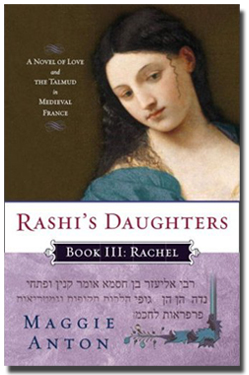
This past Shabbat, my congregation welcomed Maggie Anton, author of the Rashi's Daughters books. She actually has speaking engagements lined up all over Chicago for the weekend, and throughout the Midwest in upcoming days. Since we were her first Chicago stop, though, I got to pick her up at the airport. Why is this exciting? Well, I took her out for lunch and asked her a lot of questions. After all, I have a blog and readers to entertain! I found our conversation to be so wonderful, it was such a delight to meet someone who is so interested not only in the study of Talmud, but in making it accessible to the usually-non-Talmud-studying public.

Our conversation was long and varied, so I tried to take notes as best as I could...

PAS: I read in your bio that you got into all of this because you were a voracious reader. Are you still? What have you read lately?

MA: I wrote the book that I wanted to read. But now I can't just read, it has to take me out of critique mode. Sometimes I treat it like research - seeing how a certain author did certain stuff. I liked Harry Potter, I really wanted to see how she ended the series. I just read City of Thieves and liked it.

PAS: Which is your favorite among the books and characters?
MA: I think Book 3 (Rachel) is the best-written. Not just because I had the most experience but because the editor at Penguin was a real editor. Almost every piece of advice changed the book for the better and made it a better book.

Book 2 (Miriam) has my favorite characters. I love Judah. I really got into him. I was determined to portray him in a sympathetic light. I don't have a favorite girl.

Book 1 (Joheved) is my favorite ending. Even today I read it and it brings tears to my eyes. The book had already gone to the publisher when I found new research about Brit Milah. If I didn't know something [if it wasn't available to be known historically], I would default to modern practice. I found out that Brit Milah was done on the mother's lap. The Brit Milah kiddush, the wine cup was held by the mother - she was an integral part of it. In those days, there were 2 parties for a Brit Milah - the mom's family threw the one before and the dad's family the one after. At the first party, the host from the mother's side would announce the name and blessing; he was a male representative of the mother. Rashi finally gets his male grandson and he gets to say the name and he has to make the blessing. What an emotional ending. I really love that ending. Both of my grandsons were circumcised on my lap.

PAS: I read your latest blog post (1/26/2010) about viewing the Talmud as legend or fact. Where would you say you fall on the spectrum, do you have an answer? *Maggie is currently researching 3rd and 4th century Babylonian sages, in particular Rav Hisda and his daughter. From her blog: "In the end, I realized that I was tired of 11th-12th France, that I wanted to immerse myself in another place and time. So for my next historical novel, tentatively titled RAV HISDA'S DAUGHTER, I'm moving back in time to 3rd-4th century Babylonia [Persia/Iraq]. I waited for the new year to let you all know, and I plan to devote most of 2010's blog posts to describing my research, and eventually, my writing process. I expect to devote myself to research for at least a year before beginning to write, although I already have some scenes in mind."

MA: Personally, I'm not sure. It's shocking for me to hear that they might all be legend! In the small research that exists, there are so many contradictions. If I'm going to write this [her next project], I will have to throw out inconsistent information. My characters are the people in the Talmud. I need to have the historicity correct, but how important were these sages? We know that they didn't answer criminal law, only small claims court. There was a whole other court system in place (in Babylonia). It's clear that they didn't have power. What I haven't decided is - How important do I make them? Did people see them as fruitcakes who have no influence on their lives? There are so many pieces.
(Ima's note: This became a much longer conversation about research and Talmud. I couldn't keep up taking notes and I wasn't recording the conversation. Suffice it to say - I had a great time!)

Regarding the research she's doing: A lot of the information I'm using has only been published or available in the last 20 years. Some of it has only been translated into English in the last 10 years.
Ima's note: This was also a really interesting conversation - how Maggie finds her materials, who is doing the research, how it gets disseminated and how she accesses it. She said that now the scholars have heard of her and what they typically say is: "my wife loves your books!" - and then they're willing to help her out.

I found Maggie to be incredibly passionate about the work she's doing, and incredibly passionate about spreading the concept of Talmud-learning into the Jewish world, in particular to the Progressive movements and to women. She spoke non-stop for almost an hour to my congregants, who sat enthralled. She almost never mentioned her books specifically, but instead spoke about Rashi and about Talmud and its implications for us. It was remarkable, and I'd love to give her free reign to teach for a whole day (I'll work on that for future events). For me personally, I loved hearing how she explained Rashi and the need for his commentary on the rather, um, shorthand (cryptic!?) language in the Talmud. It's so much fun to hear how someone else teaches something. I took a lot of mental notes for my next Talmud class!

Thanks, Maggie! I'm looking forward to your next visit (and your next book)!